How to Cope With
How to Cope With
You have permission to post this, email this, print this and pass it along for free to anyone you like, as long as you make no changes or edits to its contents or digital format.
Please do pass it along and make many copies.
I reserve the right to bind it and sell it as a real book
This book is general in nature and not meant to replace any specific advice. The author disclaims all and any liability to any persons whatsoever in respect of anything done by any person in reliance, whether in whole or in part, on this e-book.
Death may be a normal and unavoidable stage in the cycle of life, but that doesn't soften the blow. Losing someone close to your heart still remains the most painful of all life’s experiences.
In my experience, despite all the pain, loneliness, and intense sorrow that the death of a loved one brings, one thing is clear - people are remarkably resilient.
Given time and the loving help of family and friends, most people eventually find themselves able to hold on to the memory of the one they have lost and move on - their life may be very different than it was before but it does go on.
My life experiences, both personal and professional, have taught me that there can be no “right” way to grieve. And, that accepting this and giving yourself permission to grieve in a way and at a pace that suits you, is a powerful first step in the healing process.
This publication contains many practical ideas to support you through your grief - from caring for yourself to finding ways to honour and remember your loved one.
May they ease your sorrows, hasten your healing, and help you find new meaning and move on with your life.
Joyce
Funeral Celebrant
Joyce is one of Perth's most highly rated and best-loved Celebrants.
She is widely regarded, by both peers and clients alike, as a caring and compassionate person and a consummate professional.
Joyce is no stranger to grief. As an experienced Funeral Celebrant Joyce has helped comfort and guide numerous people in their time of loss.
In this guide, Joyce shares some of the wisdom she has gained - both from comforting others and from being comforted herself in times of grief.
Inside, you will find useful resources and proven practices that will help guide and support you as you grieve the loss of your loved one.
Chapter One
Thomas Lynch
Grief can affect both the mind and the body in dramatic ways. Fortunately there are healthy ways to ease the pain.
Coping with the loss of someone you love is one of life’s greatest challenges. At such times, the pain of loss can feel so great it can be overwhelming.
You may experience all kinds of difficult and unexpected emotions, from shock or anger to disbelief, guilt, and profound sadness.
The pain of grief can also disrupt your physical health, making it difficult to eat, sleep, or even think straight.
These are all normal reactions to significant loss and there are healthy ways to cope with them that, in time, can ease your pain, help you come to terms with your loss, and let you move on with your life.
Shock and disbelief. Immediately after a loss, it can be hard to accept what happened. You may have trouble believing that someone you love has died and
Sadness. Profound sadness is probably the most universally experienced symptom of grief. It can lead to feelings of emptiness, despair, or intense loneliness. You may also cry a lot or find it difficult to maintain an interest in the life going on around you.
Guilt. You may feel guilty about things you did or didn’t say or do. You may feel guilty about your feelings particularly if you feel relieved when their death is the result of a long and difficult illness. You may even find yourself feeling guilty for doing nothing to prevent the death- even if there was nothing you could have done.
Anger. Feelings of anger and the need to blame someone for the injustice that was done to you are common. You may find yourself angry with God, the doctors, yourself, or even the person who died: how could they abandon you?

Fear. The loss of a loved one can trigger a host of worries and fears. You may feel anxious, helpless or insecure when suddenly confronted with fears of your own mortality or the responsibilities you now face alone.
We often think of grief as a strictly emotional process, but grief often involves physical problems. These can include:
Some people, particularly children, may have other physical complaints, such as headaches, stomach aches, dizziness, or a racing heart.
Many people experience difficulty in eating or sleeping which can lead to restlessness, memory impairment, or difficulty concentrating.
It is not uncommon to find the consumption of alcohol, tobacco, or sedatives, increasing as a result of grief.
People often experience an increase in everyday ailments such as colds and face a greater risk of hospitalisation through the worsening of existing medical conditions, such as heart disease.
It is reasonable to expect that you will not be yourself when you are grieving, but you should also know that the pain WILL soften and subside. Self-care, including giving yourself permission to be cared for, is important during these difficult times.
There is no specific time frame for grieving. How long it takes differs from person to person.
Grieving is a highly individual experience. How you grieve differs greatly from one person to another and from one culture to the next and depends on many factors including;
Inevitably, the grieving process takes time.
It can't be rushed!
Some people start to feel better in weeks or months. For others, the grieving process can be measured in years.
In Australia, we often feel the pressure of cultural expectations to reach “closure” within months or, at least, within a year of a loved one passing.
This is can be compounded by the popular misconception that there is an orderly progression of emotions that will lead to this closure.
There is not!
Whatever your personal experience with grief, it’s important to remain patient. Allow the process to unfold naturally and comfort yourself in ways that encourage a gradual acceptance of the changes your loss will bring to your life.
The truth is there is no single way to grieve and grief doesn’t conclude neatly at the six-month or one-year mark. Each of us has a different experience and if the strength of the bond that was broken is great enough, grief can even last a lifetime: parents who lose a child often say they never get over the loss.
Feelings of sadness, abandonment, loss, and even anger can be particularly pronounced around the anniversary of a special occasion. A familiar scent, song, or likeness can reignite strong feelings of grief, too.
I'll be seeing you in all the old familiar places that this old heart of mine embraces
Billie Holiday
All of this is entirely normal.
The initial shock of grief can be raw and all-consuming but it usually softens and recedes with time. Be it weeks, months, or even years, gradually, and at their own pace, most people do find themselves adjusting to their loss and easing back into the routines and pleasures of daily life.
Grieving may be a highly individual experience but there are many emotions common to the process.
There is still much debate as to whether the emotions experienced as a result of grief occur in a standard series of steps. What is clear, however, is that, as intense and permanent as the first onslaught of grief may seem, it will change over time.
The most widely accepted model of bereavement, the “five stages of grief,” was originally described in the 1969 book, On Death and Dying by Elisabeth Kübler- Ross.
These stages of grief were based on the study of the feelings of patients facing terminal illness
“Grief can't be shared. Everyone carries it alone; his own burden in his own way.”
Anne Morrow Lindbergh
These were later altered and adapted to cover many forms of loss, from divorce to the death of a loved one, with the five stages being:
Although some dispute remains, many studies have shown that the five stages of grief do tend to peak in sequence and the concept of a progression, from disbelief through emotional pain toward acceptance and the capacity to pick up the pieces and move on with your life, is common to most theories.
Contrary to popular belief, there is no absolute requirement to go through each stage in the process in order to heal. In fact, some people resolve their grief without going through any of these stages at all. But, if you do find yourself going through these stages of grief, you probably won’t experience them in a neat, sequential order.
Many who have experienced the loss of a loved one describe it as a decidedly nonlinear experience.
Instead of a series of stages, they liken it more to a roller coaster ride...
...one full of ups and downs and highs and lows where the ride tends to be steeper and rougher in the beginning.
Grief is not a tidy process so don't expect your journey from denial to acceptance to be an orderly one.
Emotions are messy. Accept that your ability to move ahead with your life will ebb and flow with your emotions as they continue to erupt at unpredictable times.
Over time, though, you should find your recovery getting easier and faster and the time between the waves of emotion becoming more prolonged.
Time, as they say, is the great healer
Chapter Two
Virginia Satir
There is a lot you can do to comfort yourself and rebuild a sense of normality in your life again.
Losing someone you love can be both physically and emotionally draining. Just getting on with life; eating, sleeping, keeping appointments, caring for your children, can seem impossibly difficult or totally inconsequential. So it is important to focus on what matters. Focus on ways to help yourself through this difficult time, and let the rest slide.
This chapter suggests a number of supportive strategies to help you cope with your grief. Don’t feel compelled to try them all. Pick only those you feel are most likely to help you and try focusing on just one suggestion at a time.
It is very easy to neglect yourself in times of grief. Maintaining structure in your life by eating well, getting a good night's sleep, and exercising regularly will not only help you physically, but it will also help to support you emotionally.
Losing a loved one turns your whole world upside down. Getting back into a familiar routine as soon as possible can help restore a sense of normality in your life and make the pain of grief more manageable.
As overwhelming as it may seem at first, a simple routine will give your day structure at a time when life seems unfamiliar and so very difficult to deal with.
Try simply getting out of bed at the same time each day. Take a shower, have breakfast and plan your day - making sure to include small things that give you comfort; a walk, a warm bath, or a cup of coffee perhaps.
Even under normal circumstances, we all need a good night's sleep if we are to function at our our best.
Grief is exhausting, so maintaining a regular sleep schedule is essential when facing the loss of a loved one.
To get the sleep you need, try going to bed early. If you’re having trouble sleeping, try exercising more - just not in the evenings.
Avoid drinks containing caffeine from mid-afternoon and avoid alcohol at least two hours before going to bed - if not completely.
Take a nap. An ideal nap is taken shortly after lunch and lasts no longer than an hour. Even a 15- to 20-minute nap can work wonders.
If these measures aren’t sufficient, talk with your G.P. It’s perfectly fine to take sleep medication in the weeks after losing a loved one.
Loss of appetite is not uncommon during periods of grief. Neither is eating more than usual for some people. Maintaining a healthy diet will help your body cope as well as possible during this stressful time.
Try to avoid foods full of mostly empty calories; lollies, chips, pastries etc.
Drink plenty of fluids but, as we have already discussed, make sure and limit the use of alcohol and caffeinated drinks.
If you’ve lost your appetite, try simple comfort foods, such as soups, smoothies, pasta, puddings, or foods from your childhood.
Snack frequently; eating less more often can often help, too.
Exercise may be the furtherest thing from your mind when you are grieving.
But, exercise does offer many benefits and can be of great help as you try to make sense of your loss and cope with your grief.
A simple walk, a bike ride, yoga, or a workout in the gym can ease stress, anger, and sadness.
Exercise can also help lift spirits and promoting a sense of well-being by releasing mood-elevating hormones.
Try getting out in the fresh air and take a walk. It may serve as a needed distraction from your grief and offer you time to contemplate on your loss.
Turning to alcohol or drugs to help you relax can be very tempting, especially when in grief.
But, it can be easy to find yourself 'enjoying' more than usual to try and numb the pain of your loss.
You may find it helps temporarily, but, ultimately, it will derail any chance of healthy grieving and leave you facing other unwanted consequences.
When the impulse to turn to alcohol or drugs strikes, try turning to safer behaviours instead - exercise, writing a journal, stress-relief techniques, or the ear of a caring friend, will all serve you better in the long run
If you do find yourself uncontrollably drawn to risky behaviours, it may time to seek professional help in making healthier choices as you grieve.
Many people consider making big changes in their life when they are grieving.
But grief can cloud your judgement and you may well end up regretting any spur of the moment decisions made at this time .
Many experts suggest waiting a year, if possible, before making any decisions that may have a major impact on your life such as; changing jobs, moving home or even throwing out previously treasured mementoes.
The loss of a loved one can magnify any troubling physical symptoms of illness.
In fact, it’s not uncommon to experience symptoms similar to those of the person you lost.
A visit to your GP will identify ailments that could see you ending up further under the weather or it may simply put your mid at ease.
Try writing down three things that went well for you each day: small victories, like going for a walk or eating a healthy meal.
This can be a great help in restoring a sense of normalcy in your life.
For those fortunate enough to have them, the compassionate support of friends and family cannot be underestimated in times of grief and bereavement.
For those less fortunate without the kindness of loved ones to sustain and console them in this difficult time, a councillor or bereavement group may be needed to providesupport.
Whatever your personal situation the following suggestions may be of help.
It can be hard for family and friends to know how to act around you in times of grief.
How should they start a conversation? Should they offer advice? Should they just reach out and hug you?
It can be a confusing and uncomfortable time for them. It will help everyone if you can provide clear signals.
Be honest about your feelings, tell them what helps, and take away any uncertainty for them by saying things like:
For those not fortunate enough to have a strong support network around them or those where months, or even years, have gone by with little, or no, reduction in their grief, the answer may lie in seeking out a support group or a mental health professional.
If you think you could benefit from talking about your experiences and listening to those of others in a similar situation to yourself, you may find a support group quite helpful.
Sometimes friends and family members can find it hard to understand what you’re going through. Even the most caring of friends or relatives shy can away from dealing with strong emotions and difficult topics, leaving you even more isolated and feeling worse.
A good grief support group can offer understanding, a sense of connection and a safe place for you to express your strong feelings and emotions, and where you may receive good advice from those who really understand what you are going through.
Your doctor or therapist should be able to help you locate a suitable support group.
If, after trying a few sessions, you find you it's not helping or it's making you feel worse, don’t feel compelled to keep going. It may well be that you need to consider one-on-one counselling.
Working with a counsellor or therapist who specialises in grief will not be necessary for everyone.
But for those that don’t think a support group is right for them, or if the passing of time hasn’t eased their pain and they suspect that they may be struggling with complicated grief or even depression, then seeking the help of a professional grief counsellor might be the right thing to do.
Grief counsellors are specialists attuned to both the physical and the psychological reactions common to grief.
They are skilled in helping individuals process and make sense of their feelings of loss and helping them come to terms with their grief.
If you feel you would benefit from talking to a mental health specialist or
grief counsellor you should talk to your G.P. and ask for referrals.
It’s important that you feel comfortable with your therapist. Arranging an initial meeting can help you decide if the fit is a good one.
The most common feature of complicated grief is an intense, unremitting yearning for the loved one you have lost.
Complicated grief also includes at least four of the symptoms below:
You should consult your G.P. if significant time has passed and you find yourself experiencing any combination of these symptoms.
A good fit will depend partly on a professional’s personality and approach, as well as their experience
Custom dictates that we mark the passing of a loved one with a funeral, wake, or memorial service. But, there are many additional ways you can acknowledge their loss and honour their life.
If you are looking for a way to keep the memory of a loved one alive and, perhaps, even help shape meaning from your loss, the suggestions that follow may be helpful.
Planting a tree or a memorial garden can be a wonderful way to remember someone.
Flowers from the garden can be shared with family and friends or in arrangements taken to the cemetery.
If the tree is not planted in your own garden, an annual visit to mark your loved one’s birthday can become a comforting family tradition.
Build a serene spot in your garden. Create a peaceful nook indoors with a comfortable chair, photos, or other meaningful objects in honour of your loved one.
Regularly visiting a spot your loved one particularly enjoyed; a nature preserve, an ornamental garden, a museum, or an art gallery perhaps, can be another great way to maintain a connection and keep their memory alive.
Create an album celebrating your loved one’s life. Include a timeline of important dates and events.
You might also paste pictures, write down stories, sayings, and well-loved recipes.
Consider inviting friends and family to write down stories or their treasured memories of your loved one, that you can then share with friends and family.
When enough time has passed and you’re ready to go through your loved ones belongings, make a point of setting aside items of special significance that you can keep in a memory box.
Photographs, letters, recipes, nick-nacks; many small and meaningful items can be brought together to make a memory box you can either display or save as a keepsake.
There are many good causes that can be supported to honour someone’s memory; medical research, violence prevention, scholarship funds, the list is endless. How might your loved one want to be remembered in the world?
Create a Facebook page in your loved one’s memory. You may be surprised at the number of people who want to contribute and how often they do with stories you’ve never heard or photos you’ve never seen before.
Chapter Three
Hellen Keller
How to navigate the maze of planning, preparation and paperwork, that you are inevitably faced with on the loss of a loved one.
The death of a loved one can see you plunged head-long into what can seem like a never-ending wave of planning, preparation, and logistics.
Arrangements that would be difficult enough at the best of times never mind at the most difficult time of your life.
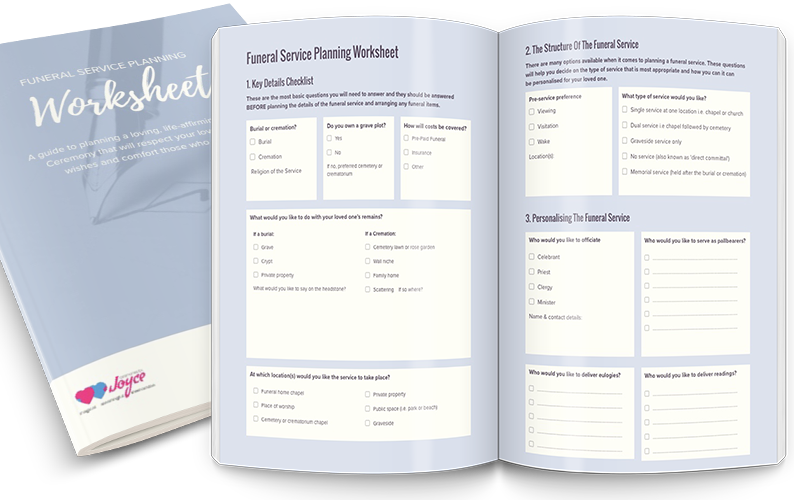
This chapter and the accompanying Funeral Service Planning Worksheet will guide you through this complex and often confusing process.
Some people document their funeral wishes before they die; the type of service they prefer, the hymns or music they would like or whether they would prefer to be buried or cremated, for example. If not, be guided by what you know of your loved one’s wishes.
Your aim should be to plan a memorial that not only respects your loved one's wishes but is meaningful and comforting to you and those who mourn with you.
You might want to start by considering these questions:
Your Funeral Service Planning Worksheet will give you plenty of space to jot down your answers to these questions.
There are other, more mundane, details that must be also be considered. Such as:
The Funeral Service Planning Worksheet can help you gather this information.
Make a start by downloading your worksheet now and filling in as much information as you have to hand, including any instructions, directions, and phone numbers.
Like everything else today, the cost of dying - including the price of funerals and memorial services - is steadily rising. At the time of writing, according to ASIC MoneySmart funerals can cost anywhere from $4,000 for a basic cremation to around $15,000 for a more elaborate burial.
There will be few times in your life where you will be more vulnerable to sales pressure than after losing a loved one.
Try not to let guilt or the fear of what people may think influence you.
A simple, loving ceremony can dignify a person’s memory just as well as a lavish, costly one can.
It’s always a good idea to contact several funeral homes. Differences in facilities, attitude, and cost may surprise you.
Those we love never truly leave us… there are things that death cannot touch.
Jack Thorne
If you are paying for a partner's funeral, their bank may be able to release money from their account to help pay funeral expenses before the court validates their will.
If you think your partner had a funeral bond or made pre-paid funeral arrangements but you can't find the paperwork, check with your solicitor or the executor of the estate. Some private health and life insurance policies, also pay some funeral costs.
Organisations such as the Department of Human Services and the Department of Veterans' Affairs and can help with the cost of a funeral.
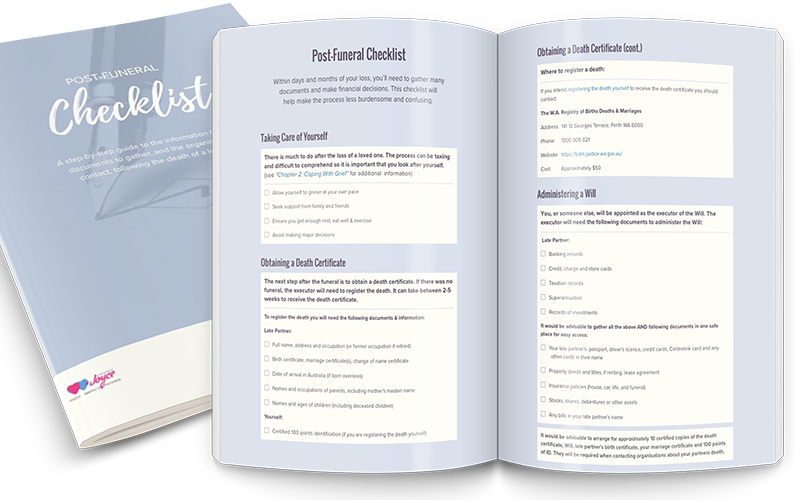
The Post-Funeral Checklist has contact details and information on the documentation required when requesting assistance.
Gathering all the information and essential paperwork you will need after the death of a loved one
Within days and months of your loss, you’ll need to gather many documents and make financial decisions.
You may find this less burdensome and confusing by making yourself familiar with what you’ll need and try to collect some of these items before you find yourself under pressure to do so.
The following two sections and your Post-Funeral Checklist will guide you, step-by-step, through this complex and often confusing process
You (or the executor) will need to gather your late partner’s documents to register the death. You will need:
It would be advisable to arrange for around 10 certified copies of your loved one's death certificate, will, and birth certificate, along with your own 100 points of identification and marriage certificate, to be held in a safe place for easy access.
Hopefully, your partner will have left a 'will' or legal document setting out how they want their personal assets to be distributed after their death.
The executor will be responsible for finalising any debt and taxes your partner owed. Assets can only be distributed after debts are paid and the Supreme Court has validated the will.
The executor will need the following documents to be able to administer the will:
If your partner dies 'intestate' (or without a will), their assets will be distributed according to a pre-determined formula by the government.
Download your checklist now and make a start on gathering all the information and essential paperwork you will need after the death of your loved one .
Organisations to notify about your late partner's death
The following is a suggested list of organisations and companies you may need to contact to cancel or change the details of your late partner’s accounts into your (or the executor’s) name.
You will find full contact details and the information required for each organisation on your Post-Funeral Checklist.
If you are experiencing difficulties with your grief or are in need of support these services might help:
Call: 13 11 14
Griefline Counselling Phone Service
Call: 1300 845 745
Beyond Blue Call: 1300 224 636
But at some point, you will want to contact alumni magazines or newsletters of organisations your loved one was involved in.
If your loved one kept a greeting card list of old friends you haven’t seen for years, you’ll want to let the people on this list know, too.
The death of a partner can often mean a period of financial uncertainty or anxiety. The following free services can help:
SPECIAL SECTION
Knowing what to say to a bereaved person can be difficult. If you find yourself tongue-tied or uncertain about what to do in the face of someone’s loss, here are some ideas you may find helpful.
Don’t be afraid to mention the deceased by name. It may prompt some tears, but It won’t make your friend any sadder. Saying how much you’ll miss the person is much better than a token, “I’m sorry for your loss.”
It's important to offer reassuring hope without being flippant. Saying something like, "Grieve for as long as you need. You are a strong person, and will find your way through this.” has the benefit of both acknowledging that there is no quick solution and affirming your confidence that things will get better.
A sympathetic ear is a wonderful thing. People often work through grief by telling their story over and over. Unless you are asked for advice, don’t be quick to offer it. It’s your understanding—not your advice—that is most sorely needed.
Your friend’s life and emotional landscape have changed enormously, possibly forever. You may wish he or she would move on, but you can’t speed the process or even ensure that it happens. Let your friend heal in their own way and at the pace that feels right for them.
Some people appreciate hearing that you’re thinking of them at difficult times, such as holidays, birthdays, and anniversaries. Be mindful that that sad reminders can make some people feel worse, so take your cues from your friend.
"Death leaves a heartache no one can heal, love leaves a memory no one can steal."
Anon.
If you share your friend’s sorrow, say so. It’s even alright to let them know that you don’t know what to say. Most likely, nothing you say will turn the tide, but your sympathetic presence may make your friend feel slightly less alone.
As author Kristina Morris points out, "The whole world can become the enemy when you lose what you love."
People who are grieving sometimes direct angry feelings toward the closest target. If that happens to be you, try to be understanding. Being critical or reacting to their anger certainly isn’t helpful.
Bring dinner over, answer the phone or clean up the kitchen. Asking if there is anything you can do simply transfers the burden to the bereaved and they may not be willing to make a request.
People grieve in different ways. Ethnic, cultural, and family backgrounds play a big part in how death is handled. Avoid criticising arrangements and try not to impose your beliefs on your friend.
"There are three needs of the griever: To find the words for the loss, to say the words aloud and to know that the words have been heard."
Victoria Alexander
Ask your friend to join you once a week for low-stress activity like a walk or a cup of coffee. Weekends can be a difficult time or those experiencing grief, so it is often a good time to suggest an activity.
Sometimes just being there without saying much can be enough—it may even be exactly what your friend wants.
If you offer to do something, make sure that you follow through. This is really important, particularly with children. For a child, the loss of a loved one is abandonment enough.
In the wake of any tragedy, children, regardless of their age, tend to worry most about what will will happen to them.
Over and above giving them hugs and affection and reassuring them that they are loved and will be cared for, the following can be done to help children grieve.
Sadness, tears, laughter, hurt, anger, relief—try to let your child share her or his feelings with you.
Despite the loss of your loved one, you are still a family, albeit a smaller one.
It’s important to honour that by continuing to do things that you all enjoyed doing together as a family.
Your loved one may be gone, but he or she is still an important person in your child’s life story. Talk about them often. Share with your child all the things that made your loved one special and just how proud he or she was of that child.
If you’re grieving, this advice may seem impossible. But remember, a child needs to know that it’s ok to take a break from grief, to have fun again, and to spend loving time in your presence. Let the child be a child.
Moving house, missing special events, and not having someone cheering from the sideline or supporting them at school events, are all examples of secondary losses.
Whenever possible, try to maintain your child’s routine and be aware of feelings that can arise as a result of any unavoidable changes.
THE 3 BIG QUESTIONS ALL
KIDS NEED ANSWERS TO
Research has shown that when someone close dies, children need a caring answer to three big questions:
Your child may never actually ask any of these questions out loud, but you can relieve some of their pain and anxiety by raising and addressing these questions yourself.
Very young children are unlikely to fully understand their loss. Providing simple explanations, addressing misconceptions, and offering patient reassurance can help them better understand and cope with their loss.
Offer simple explanations. What does death mean? Be very clear and simple in your explanations, “Uncle Jack was so sick that his heart stopped beating and his body stopped working.” Explain that death is permanent and that once a person dies, they cannot come back to life no matter how much we might want them to.
Avoid misleading answers. Saying that “Daddy is sleeping” suggests he’ll wake up. Stating that “We lost Aunt Alice” implies she can be found. “God took Jimmy early because he was so good” might raise many concerns, rather than soothe a sore heart.
Reassure your child. Will you die young too Daddy? Avoid making false promises. Instead, explain that it is very unusual for someone to die so young.
More than anything though, tell them over and over that you love them and you will get through this together.
Address magical thinking. Children this age often engage in magical thinking. They may worry that they provoked the death with an angry thought or outburst like, “I hate you! I wish you were dead!”.
Reassure your child that nothing they thought, said or did caused the death.
You might say, for instance, “Some children believe something they did made someone die. It’s not true. Mummy died because she was very, very sick. Nothing you did, said, or thought made her sick.”
Be patient with repetition. Children often ask the same questions over and over as they try to form a concept of death. Patiently answering questions - even those that are upsetting - helps them to do this.
Slightly older children need to know that, despite the loss, life will continue in a safe and normal pattern and that they will be cared for. They may need reassurance that they are not to blame, as well as comfort and support. Older children also need a fuller explanation of the death.
Offer more information. A child this age may want to know more details: “What was wrong with Dad’s heart? How did the doctors try to fix it? Where is his body now?” She or he can grasp the concept that death is permanent and may have many questions. Be guided by these questions in choosing what information to offer.
Provide reassurance. Children this age also need to hear that they didn’t cause the death.
Remind them of all the things that won't change - their friends at school, their classes, their sports, their house, the rest of the family.
Don’t be afraid to continue activities that you all did together as a family
"Nothing in this world compares to the comfort and security of having someone just hold your hand."
Richelle E. Goodrich
Be a good listener. Children may have many more questions than they openly ask, especially if they’re worried about upsetting you.
Tell them it’s okay to ask about anything, even questions that seem silly. You might ask other caring adults to do the same.
Teenagers often turn to their friends for support, but they will still need answers, reassurance, and comfort from their family.
Let them ask questions and share feelings. Teens are not yet adults, although some try to act very mature. Listen closely, offer hugs, be willing to share information when they ask questions, and involve them in decisions about services and funerals.
Reassure them. Teens also need to be reminded that nothing they did, or didn’t do, caused the death.
Adolescence brings a need for greater independence. This can prompt conflicts and complicate grieving.
A parent’s death can be especially hard at this time, because the teen may feel guilty for having pushed away emotionally from the parent and have strong conflicting feelings.
Expect conflict. Teenagers, especially older teenagers, are struggling to define themselves independent of their parents.
With the death of a parent it's not uncommon for a teenager to feel conflicted about being with family or being with friends.
This can often play out as anger or avoidance of the family.
Give them time with their tribe. Often, teens want to talk to and spend time with friends. Grieving together can bring them enormous comfort.
Before the day of the service, take time to describe the sights, sounds and emotions your child may experience there; share what the room will look like, who will be there and how they might feel and act.
Discuss how they might like to say goodbye. Encourage your child to honour their loved one in a way that feels meaningful to them; writing a poem or song, creating a drawing, or doing something the deceased enjoyed, can all be satisfying to a child.
Most experts believe that forcing a reluctant child to participate is not a good idea. If your child doesn’t want to attend a funeral or service, discuss what’s worrying them and try to alleviate their fears with honest answers.
Join me for a friendly chat over a cup of tea or coffee to talk about your ceremony and find out if we are a good fit for each other.
No Pressure. No Obligation.
Tel: 0415 449 894
Email: [email protected]